Honey oak cabinet paint colors that work with your counters and floors, and how Reno's bright light shifts whites and blues. Get a free estimate.
Start with what stays in your kitchen
Most people searching for honey oak cabinet paint colors are not starting from scratch. The counters, floors, and backsplash are staying put, and the cabinets are the one big thing you can change without a full remodel. So the right color is not the one you saw in a magazine. It is the one that looks good next to what you already own.
Before you look at a single swatch, work out the undertones of your fixed surfaces. Beige and cream laminate often leans yellow. Speckled granite can lean gold, red, or gray. Tile floors may be warm tan or cool gray. Honey oak itself is orange-yellow, and that warmth can follow you into your choice if you are not careful. Pick a paint that either agrees with those undertones or clearly contrasts with them. The colors that look muddy are usually the ones that sit halfway between the two.
Honey oak cabinet paint colors that pair with common counters and floors
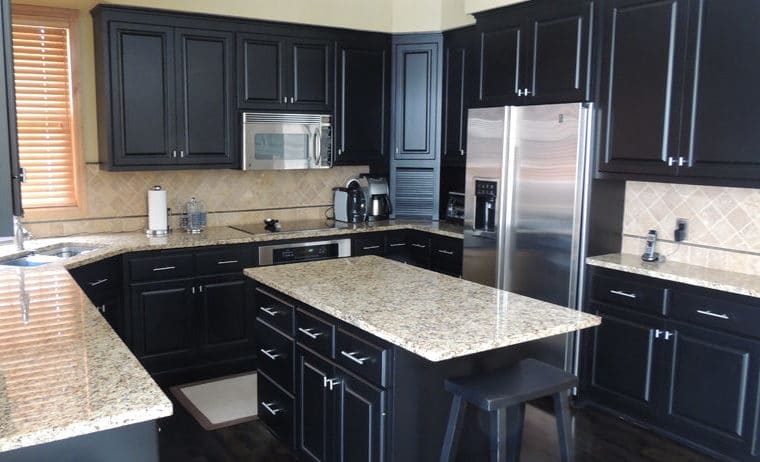
If you have beige, tan, or gold-flecked granite, warm whites and soft greige tones are the safest bet. A creamy off-white keeps the kitchen feeling continuous instead of fighting the counters. A mid-tone greige can make older tan counters look intentional. Avoid stark, bluish whites here, because they make the counters look yellower by comparison.
If you have gray or white quartz, or cooler tile, you have more freedom. Soft white, light gray, and muted green-gray all work. Deep navy or charcoal on lower cabinets, with a lighter color above, is a popular way to hide wear and give a dated kitchen some contrast. Just make sure the blue has a bit of gray in it so it does not clash with warm floors.
If you have red-toned wood floors or orange-leaning tile, lean toward colors that calm that warmth: sage, gray-green, or a soft taupe. Matching the floor with a similar wood tone on the cabinets tends to look heavy, so a painted finish in a lighter or cooler shade gives the room some relief. Black hardware, brushed brass, or satin nickel can then pull everything together.
How Reno light shifts whites and blues
Reno sits at about 4,500 feet, where the sun is strong and the air is dry and clear. That light is brighter and often cooler than what you see in a paint store. A white that looked soft under store lighting can turn crisp, even slightly blue, in a south or west-facing kitchen at midday. A bright cool white also shows every bit of yellow in the counters or the old oak edges nearby.
Blues behave similarly. In strong afternoon sun, a medium blue can look lighter and more saturated than the chip. In a kitchen with little direct light, or on a gray winter morning, the same blue can fall flat and read as gray or even dull. In the late afternoon, low winter sun warms everything up, so whites look creamier and blues can shift toward green. That is why a blue-gray with some warmth in it tends to hold up better in our light than a pure, icy blue.
For whites, a good rule is to choose one with a soft, warm base unless your kitchen is full of cool gray and daylight. It will still read clean in Reno's bright light without looking sterile. In kitchens with big windows, we often steer people one step softer than the color they first pick.
Test colors the right way before you commit
Paint large samples, at least two feet square, on poster board or a primed scrap of cabinet door, and tape them up next to the counters and the floor. Look at them in the morning, at midday, in the late afternoon, and at night under your actual bulbs. Bulb color matters. A warm 2700K bulb and a cooler 4000K bulb can make the same cabinet color look like two different shades.
Also look at the sample next to your appliances and your backsplash, not only on its own. Stainless steel picks up the color around it, and a white that looks right in the daylight can look off next to a black or bisque appliance. Give yourself a couple of days with your top two choices before you decide.
What a lasting finish on oak takes
Honey oak has an open, deep grain that shows through paint unless it is dealt with. If you want a smooth, modern look, the grain needs to be filled. If you like a bit of texture, a quality primer and sprayed topcoats will leave a subtle grain that looks deliberate. Either way, the finish only lasts if the prep is right. Our process is simple: remove and label the doors and hardware, degrease and sand, prime and spray, then reinstall. Kitchen grease and hand oils have to come off first, or the paint will not bond.
For topcoats we use Sherwin-Williams Emerald Urethane or a catalyzed pre-cat lacquer, depending on the kitchen. We choose based on hardness and cure time. Paint can feel dry within hours, but a full cure takes longer, so treat the cabinets gently for the first couple of weeks. Our dry Reno air helps coatings flash off, but it also means the temperature and airflow in the work area need to be controlled so the finish levels out properly. It is usually best to keep the space in a comfortable range, around 60 to 80 degrees, which is easy to do indoors in fall and winter.
Most kitchens take 5 to 7 working days, and you keep use of your kitchen for most of that time. Most Reno kitchens run $4,500 to $8,500, compared with $25,000 or more for new cabinets. An estimate sets the final number, since door count, condition, and the color change all play a part.
When to call a pro and get a free estimate
Cabinet painting is one of those jobs that looks easy and is not. If you are changing from honey oak to white or a pale color, or you have a lot of grain, damaged edges, or years of kitchen grease, the prep alone can take more time than most people expect. A brushed finish on oak tends to show brush marks and wear quickly. A sprayed, properly cured finish is much harder to chip.
Fall is a good time to book. Our exterior season runs roughly from April to October, but the cold months are when interiors and cabinets are easiest to schedule, and your kitchen can be ready before the holidays. Battle Born Painting is an owner-led, PCA member, licensed and insured company with a written warranty, and we offer 0% financing on approved credit. We can even give virtual cabinet quotes from photos.
Call Will and the team at (775) 414-4843 for a free estimate in Reno, Sparks, or anywhere in Northern Nevada. We will help you narrow your color choices based on your counters, floors, and light.
Quick answers
What is the best color to paint honey oak cabinets?
It depends on your counters and floors. Warm whites and soft greige suit beige or gold-toned counters, while soft white, gray, sage, or muted navy work well with cooler quartz and tile. Test large samples in your own kitchen first.
Do I need to sand honey oak cabinets before painting?
Yes. Degreasing and sanding come first, followed by a bonding primer. Skipping that prep is the most common reason paint on oak peels or chips. Filling the grain is optional and depends on how smooth you want the finish.
How long does it take to refinish kitchen cabinets?
Most kitchens take 5 to 7 working days, and you keep use of your kitchen for most of that time. Full cure takes longer, so go easy on the cabinets for the first couple of weeks.
How much does it cost to paint honey oak cabinets in Reno?
Most Reno kitchens run $4,500 to $8,500, compared with $25,000 or more for new cabinets. An estimate sets the final number, so call (775) 414-4843 for a free one.