Painted cabinets peeling? Learn why DIY cabinet paint fails in Reno kitchens and how pros prevent it with degreasing, sanding, priming, and spraying.
Why painted cabinets peeling is so common after a DIY job
Most homeowners who call us about painted cabinets peeling did a careful job. They picked a good color, bought decent paint, and took their time. The finish still started chipping near the handles or lifting off by the stove within months. The paint is rarely the main problem. The cause is almost always what happened before the first coat went on, and what happened in the weeks after the last one.
Four things cause nearly every failure we see: kitchen grease left on the surface, a skipped bonding primer, a topcoat that was never meant for cabinets, and not enough cure time. Each one is easy to miss if you have not refinished cabinets before. Together, they explain why a weekend project can look great on Sunday night and tired by spring.
Kitchen grease is the first thing that breaks the bond
Cooking puts a fine film of oil into the air, and it settles on every surface in the kitchen. Cabinets near the range and above the fridge collect the most, and door edges pick up skin oils every time someone opens them. You may not see the film, but paint can feel it. Paint applied over grease sticks to the grease, not the cabinet, and the whole coating can peel away in sheets.
An all-purpose spray cleaner and a rag will not fix this. Many household cleaners leave their own residue behind. We use a dedicated degreaser, rinse it off, and let the wood dry before any sanding starts. If we sand first, we just grind the oil into the pores. A simple check helps: if water beads up on a cabinet face, there is still a film on it.
A skipped bonding primer leaves paint with nothing to grip
Factory cabinet finishes are hard and slick by design. Paint rolled directly over them, even after a light wipe-down, sits on the surface like a sticker. A scuff sand with fine grit, typically in the 180 to 220 range, gives the surface a tooth. The goal is a uniform dull profile, not bare wood. After sanding, every speck of dust has to come off, or the primer will bond to dust.
Then comes the bonding primer, the step DIYers skip most often because it adds a day and a cost. Primer is the layer that locks to the old finish on one side and gives the topcoat something to hold on the other. On oak and other open-grain woods, the right primer also blocks tannin bleed that can stain a white finish yellow. When chips show up at door edges and around pulls, a missing or weak primer is the usual suspect.
The wrong topcoat and rushed cure time finish the job
Wall paint and basic trim enamel are soft. They feel dry in an hour, but they stay tender for weeks, and cabinets take a beating from hands, dishes, steam, and cleaning. A soft film dents, sticks to itself where doors meet frames, and wears through at the edges. Brushes and rollers add another problem: thick coats trap solvent or water underneath, which slows hardening further.
For cabinets we use Sherwin-Williams Emerald Urethane or a catalyzed pre-cat lacquer, chosen for hardness and cure time. Both are built to take daily wear. Even then, dry is not the same as cured. A finish can be dry to the touch in hours, yet take a few weeks to reach full hardness. In a Reno winter, heated indoor air is very dry, which speeds surface drying. That is fine for a sprayed finish but can cause problems for thick brushed coats. Go easy on new cabinets for the first couple of weeks: no harsh cleaners, no taping things to the doors, and no stacking items against them.
Our degrease, sand, prime, and spray process
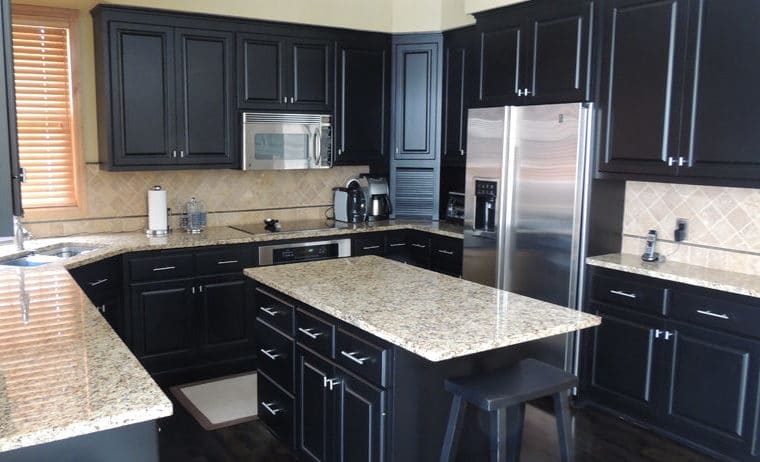
Our process has four stages. First, we remove and label every door, drawer front, and piece of hardware so everything returns to its exact spot. Second, we degrease and sand, cleaning the surfaces thoroughly, then scuffing them, filling dings, and checking joints where dry winter air has pulled the wood apart. Third, we prime and spray. Bonding primer goes on first, gets sanded smooth, and is followed by thin, even coats of the topcoat, with light sanding between them.
Spraying is what makes the difference you can see and feel. A sprayer lays down an even film with no brush marks, and it lets us keep each coat thin so it hardens properly. We pay attention to temperature as well, working in a space held to a comfortable indoor range, roughly the mid 60s to mid 70s Fahrenheit. Finally, we reinstall the doors and drawers, adjust the hinges so everything lines up, and walk the kitchen with you.
Reno adds its own twists. At about 4,500 feet, the air is dry and the UV is strong, and sunlight through kitchen windows can slowly yellow weak finishes. Big swings in humidity make wood move. We choose products and prep steps with those conditions in mind.
Timeline, cost, and why fall is a smart time to book
Most kitchens take 5 to 7 working days, and you keep use of your kitchen for most of that time. Most Reno kitchens run $4,500 to $8,500, compared with $25,000 or more for new cabinets. An estimate sets the final number, since door count, condition, and existing finish all matter. We offer virtual cabinet quotes from photos, and 0% financing is available on approved credit.
Fall is when many homeowners decide to get the kitchen done before the holidays, and interior work does not depend on the April to October exterior season. We are a PCA member, licensed and insured, and we back our work with a written warranty.
When to call a pro for your cabinets
If your cabinets are already peeling, a new coat on top will not fix it. The loose paint has to come off and the problem underneath has to be solved. Call a pro if the cabinets are greasy or heavily worn, if the finish is oak or glossy factory coating, or if you have a deadline such as the holidays or a listing. We also offer fast turnaround for realtors.
Will, the owner, and the Battle Born Painting team serve Reno, Sparks, and Northern Nevada from our shop at 429 Toano St. Call (775) 414-4843 for a free estimate, or ask about a virtual quote from photos of your kitchen.
Quick answers
Why is my painted cabinet paint peeling near the stove and handles?
Those areas collect the most grease and skin oil. If the surface was not fully degreased and scuffed, and a bonding primer was skipped, the paint has little to hold onto and lifts first where the buildup is heaviest.
How long does cabinet paint take to fully cure?
Paint can feel dry within hours, but it often takes a few weeks to reach full hardness. During that time, avoid harsh cleaners and heavy contact with the doors. Your painter should tell you how long the specific product needs.
How much does professional cabinet refinishing cost in Reno?
Most Reno kitchens run $4,500 to $8,500, compared with $25,000 or more for new cabinets. A free estimate sets the final number based on your kitchen's size and condition.
How long does a cabinet refinishing project take?
Most kitchens take 5 to 7 working days, and you keep use of your kitchen for most of that time.