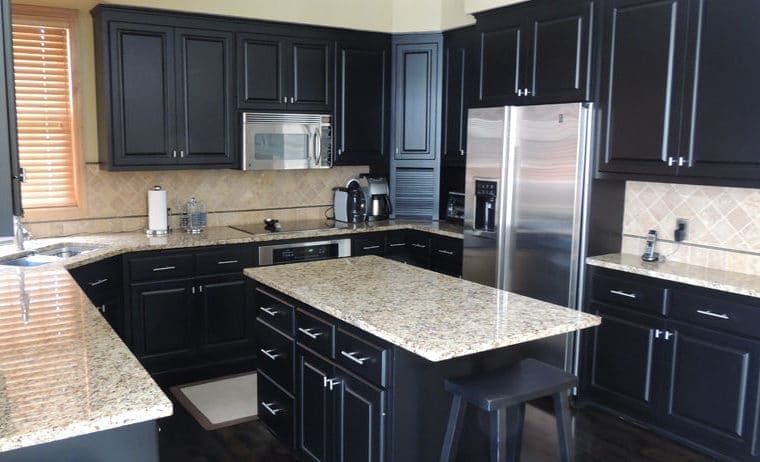
How long does cabinet painting take? Most Reno kitchens take 5 to 7 working days. See the day-by-day plan, what stays usable, and cure times before heavy use.
How long does cabinet painting take in a typical Reno kitchen?
For most kitchens, the answer is 5 to 7 working days. That sounds long if you have only painted a bedroom, but a cabinet finish is closer to furniture work than wall work. Every door, drawer front, and cabinet box has to be cleaned, sanded, primed, and sprayed, and each coat needs time to dry before the next one goes on.
The range depends on the size of the kitchen, the number of doors and drawers, the condition of the existing finish, and whether we are dealing with repairs like chipped edges or old hardware holes. A galley kitchen with flat doors sits near the short end. A large kitchen with an island, a pantry wall, and raised-panel doors sits near the long end.
The good news is that you keep use of your kitchen for most of that time. Below is how the week usually unfolds, so nothing about it is a surprise.
Days 1 and 2: removal, labeling, degreasing, and sanding
Day one starts with protection and organization. We mask floors, counters, appliances, and walls, then remove the doors, drawer fronts, and hardware. Every piece gets labeled and mapped to its opening so it goes back exactly where it came from. Hinges and pulls are bagged and tagged with their doors so nothing gets mixed up.
Next comes the step that decides whether a finish lasts: degreasing. Kitchen cabinets carry years of invisible cooking oil and hand oils, especially around the stove and the pulls. Paint will not hold to that film, so we scrub every surface with a degreaser, then rinse and let it dry.
Day two is sanding and surface repair. We scuff-sand to give the primer something to grip, fill dings and old hardware holes, and caulk gaps where the cabinet boxes meet the walls. Then we vacuum and tack the dust away. Skipping or rushing any of this is the most common reason painted cabinets peel at the edges later.
Days 3 to 5: priming and spraying
Priming comes first, using a bonding primer chosen for the existing surface, whether that is stained wood, an older paint, or a factory finish. We then spray the finish coats rather than brushing them. Spraying lays down a smooth, even film without brush marks, which is what makes refinished cabinets look factory-made.
For the topcoat we use either Sherwin-Williams Emerald Urethane or a catalyzed pre-cat lacquer. We pick between them for hardness and cure time, based on your kitchen and how hard it is used. Both are tougher than ordinary wall paint, which matters for surfaces you touch dozens of times a day.
Reno's conditions work in our favor and against us at the same time. The dry air at about 4,500 feet helps coats flash off quickly, but it also means we have to control dust and air movement so the finish lays flat. In the cooler months we keep the work area in a comfortable range, roughly 65 to 75 degrees, because cold surfaces slow drying and can affect how the finish levels out. A heated interior is one reason fall and winter are a smart time to book cabinets, since a cold snap or an afternoon wind outside does not change the schedule.
Days 6 and 7: reinstall, touch-ups, and walkthrough
Once the finish has dried enough to handle carefully, the doors and drawer fronts go back on, and hardware is reinstalled. We check that doors hang evenly, close properly, and line up across each run. If you want new pulls or hinges, this is when they go in.
Then we walk the kitchen with you in good light, looking at edges, corners, and inside the doors. Any small touch-ups happen right then. Smaller kitchens often wrap up by day five or six, and larger ones use the full seventh day.
What you can still use in the kitchen during the project
Because the work is staged, you are not without a kitchen for a full week. Your sink, stove, refrigerator, and counters stay in place, and on many days you can still make coffee and simple meals. The main limit is access to the cabinets themselves, since doors and drawer fronts are off and the boxes may be masked or freshly coated.
Plan ahead by emptying the cabinets before the first morning. Set up a temporary spot with a microwave, a coffee maker, paper plates, and a cooler or the fridge for easy meals. Expect the spray days to be the most restrictive, when we ask that people and pets stay out of the work area. Keep the kitchen closed off from dust and curious paws, and you will get the best finish.
Cure time before heavy use
Dry and cured are not the same thing. A finish can feel dry to the touch within hours and still be soft underneath. Over the first several days you can use the cabinets normally, opening and closing doors and putting dishes away, but treat them gently. Avoid slamming, avoid sticky tape or adhesive hooks, and wipe only with a soft damp cloth.
Full hardness takes longer, often a few weeks, and the exact timing depends on the product, the thickness of the coats, and the temperature and humidity in your home. This is part of why we choose between Emerald Urethane and catalyzed pre-cat lacquer based on cure time. We will tell you what to expect for your finish, including when it is safe to load heavy pots, use stronger cleaners, or put rubber mats and liners in drawers.
One more local note: Reno's dry winter air and big temperature swings can pull moisture out of wood over time. A properly prepped and primed cabinet handles that far better than a rushed job, which is another reason prep takes up the first two days of the schedule.
When to call a pro and get a free estimate
If your cabinet boxes are solid and the layout works for you, refinishing is usually the smarter move than replacement. Most Reno kitchens run $4,500 to $8,500, compared with $25,000 or more for new cabinets. An estimate sets the final number, because door count, condition, and finish all affect the price. We also offer 0% financing on approved credit.
Call a pro when the finish is peeling, the surface is greasy or worn, you want a hard, smooth spray finish, or you need the job done on a deadline, such as before the holidays or a home sale. Realtors, we offer fast turnaround. We are PCA members, licensed and insured, and we back our work with a written warranty.
You do not even need to be home for the first step. We can give you a virtual cabinet quote from photos. Call Will and the Battle Born Painting team at (775) 414-4843 for a free estimate anywhere in Reno, Sparks, or Northern Nevada, and get your fall or winter project on the calendar.
Quick answers
How long does cabinet painting take for the average kitchen?
Most kitchens take 5 to 7 working days. Smaller kitchens with fewer doors can finish sooner, and larger kitchens or those needing repairs use the full week.
Can I use my kitchen while the cabinets are being refinished?
For most of the project, yes. Your sink, stove, and refrigerator stay in place. Access to the cabinets is limited, especially on spray days, so empty them first and set up a simple temporary meal area.
How long before I can use the cabinets heavily?
You can use them gently within the first several days, but full hardness takes a few weeks depending on the product and your home's temperature and humidity. We will give you guidance for your specific finish.
How much does cabinet refinishing cost in Reno?
Most Reno kitchens run $4,500 to $8,500, compared with $25,000 or more for new cabinets. An estimate sets the final number. You can send photos for a virtual quote or call (775) 414-4843.